
Direct Thermal vs. Thermal Transfer Labels: Which Labeling Method Is Right for You?
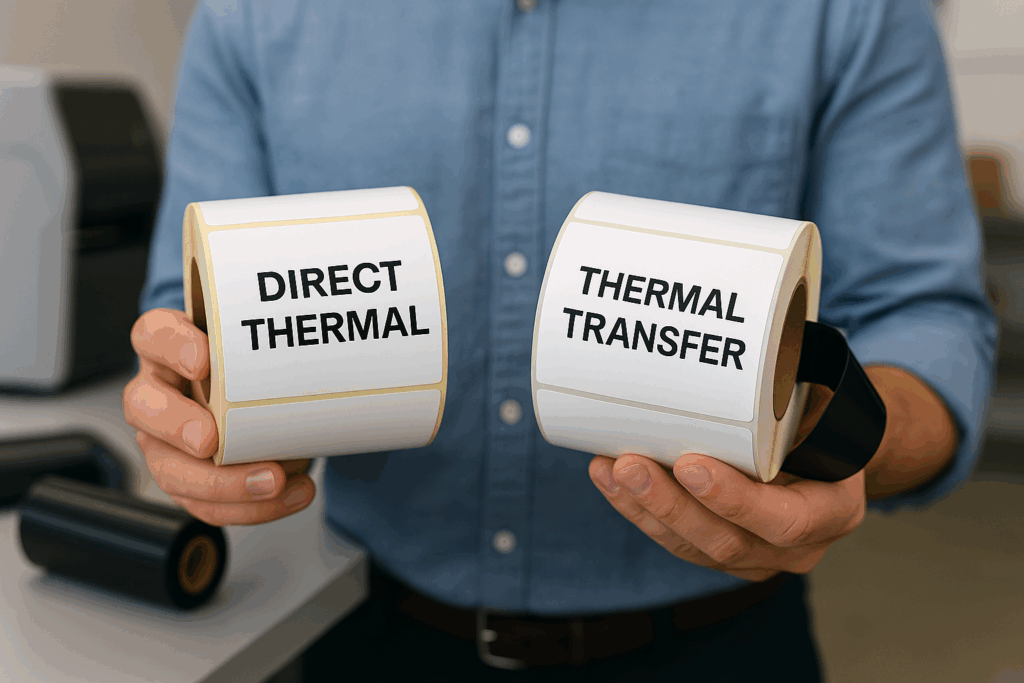
If you use labels in your business, chances are you’ve come across the terms direct thermal and thermal transfer.
They sound similar—and they are—but the differences matter when it comes to choosing the best option for your products, equipment, or logistics.
Let’s break down the basics so you can make the right call for your label printing needs.
What Is Direct Thermal Labeling?
Direct thermal printing uses heat-sensitive labels that darken when they pass under a heated printhead.
There’s no ink, toner, or ribbon involved. It’s a clean and efficient process, ideal for businesses that need fast, high-volume printing without a lot of extras.
When to use direct thermal labels:
- Short-term labeling
- High-speed, high-volume environments
- Applications where exposure to heat, light, or friction is limited
Pros:
- No ribbons or cartridges to manage
- Lower material costs
- Simple operation and maintenance
Cons:
- Labels fade over time
- Not great for high-temperature or outdoor use
- Limited durability
What Is Thermal Transfer Labeling?
Thermal transfer printing uses a heated ribbon to transfer ink onto the label surface.
This method produces longer-lasting prints and works with a wider range of label materials, including paper, polyester, and polypropylene.
When to use thermal transfer labels:
- Long-term labeling (asset tags, product ID labels, inventory management)
- Harsh environments with exposure to chemicals, sunlight, or abrasion
- Labels that need to stay legible for years
Pros:
- Excellent print durability
- Compatible with synthetic label stocks
- Great for barcodes, fine text, and graphics
Cons:
- Requires ribbon replacement
- Higher overall supply cost
- Slightly more complex setup
So, Which Should You Choose?
It depends on your use case.
If you’re printing labels that will only be handled briefly, like shipping or warehouse tags, direct thermal might be all you need. It’s fast, cost-effective, and easy to manage.
But if your labels need to stand the test of time—outdoor conditions, repeated handling, or product packaging—thermal transfer offers a longer-lasting, higher-quality solution.
The good news is that both methods are reliable.
Need Help Deciding?
We get it: labeling can feel like a small detail until it becomes a big problem.
That’s where we come in. At M&R Label, we work with businesses across industries to match the right label materials and printing methods to their needs. Whether you’re shipping products across the country or labeling bottles on a retail shelf, we’ve got a solution that works for you.
If you’re interested in learning more about our label services and would like us to provide you with a FREE quote, trust the experts at M&R Label to help you!
Ready to Start Your Label Project?
Our team of experts is ready to help bring your vision to life.
Request a Quote